
Date: February 18th, 2026
Location: NY Bagel Cafe, 14423 1/2 Ventura Blvd, Sherman Oaks, CA 91423
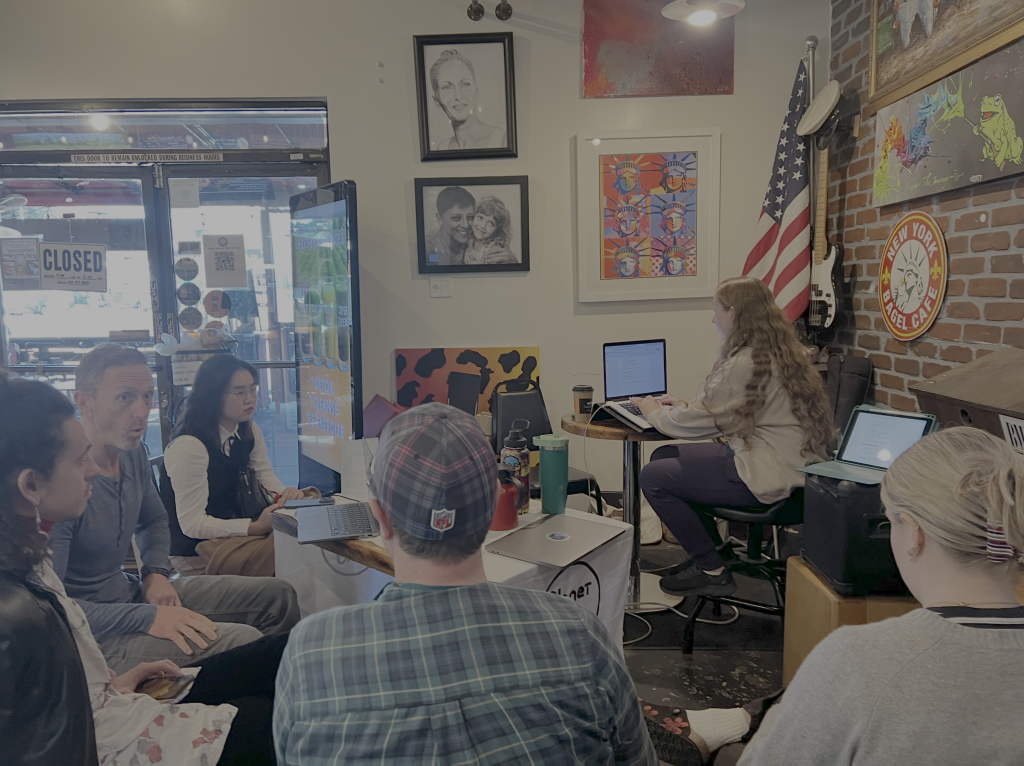
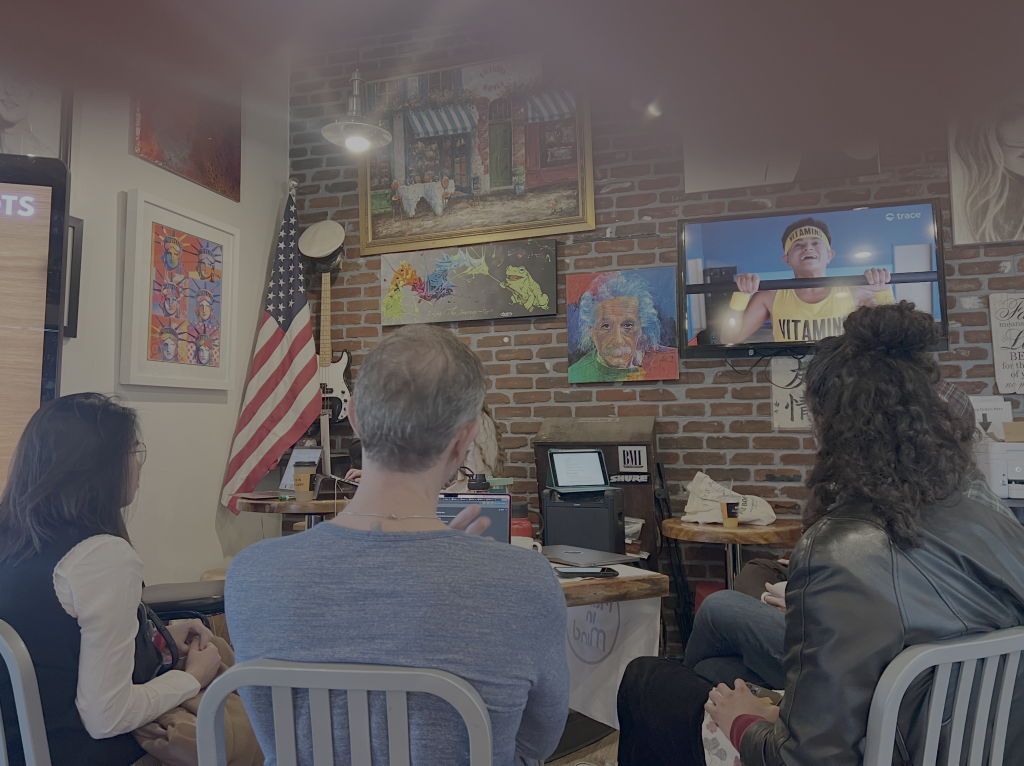
On International Worldbuilding Day — a group of creatives, thinkers, and dreamers gathered for an Idea Percolator salon hosted by Planet in Mind, Syllble Studios’ The Radical Imagination Project. The question on the table: What would a regenerative Los Angeles look like in the year 2060?
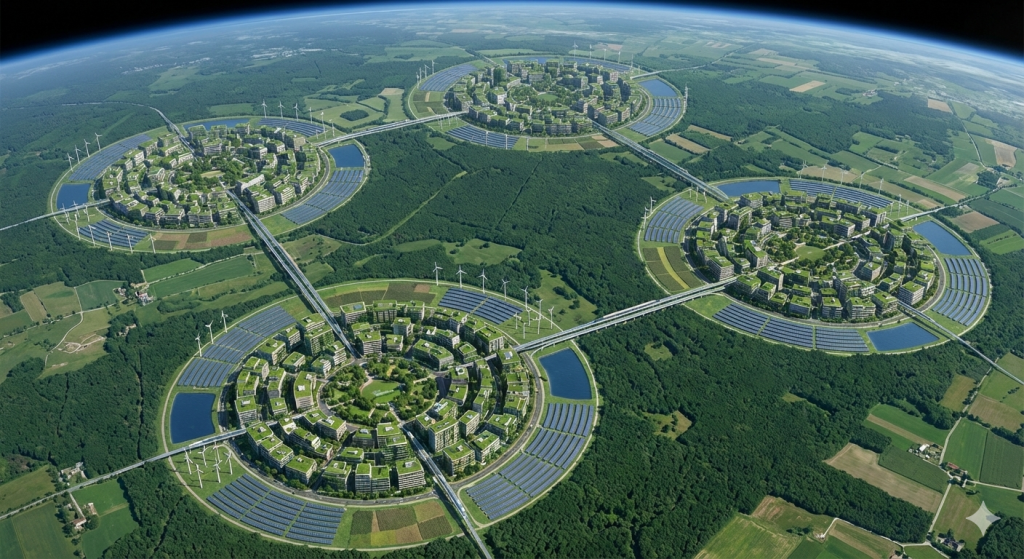
Through collaborative visioning and salon style discussion, the group began building a world. In it, Los Angeles has reorganized itself into over a thousand micro-cities, each self-sufficient and hyperlocal, all connected by a vast living food forest stretching across the Topanga corridor. At the heart of it all is La Cosescha — the first regenerative micro-city, born in the hills near Topanga, the seed from which everything else grew.
What you’re reading are the notes from that morning. A story bible, born from one conversation, about the city we chose to imagine instead.
La Cosescha
LA COSESCHA
COncept.
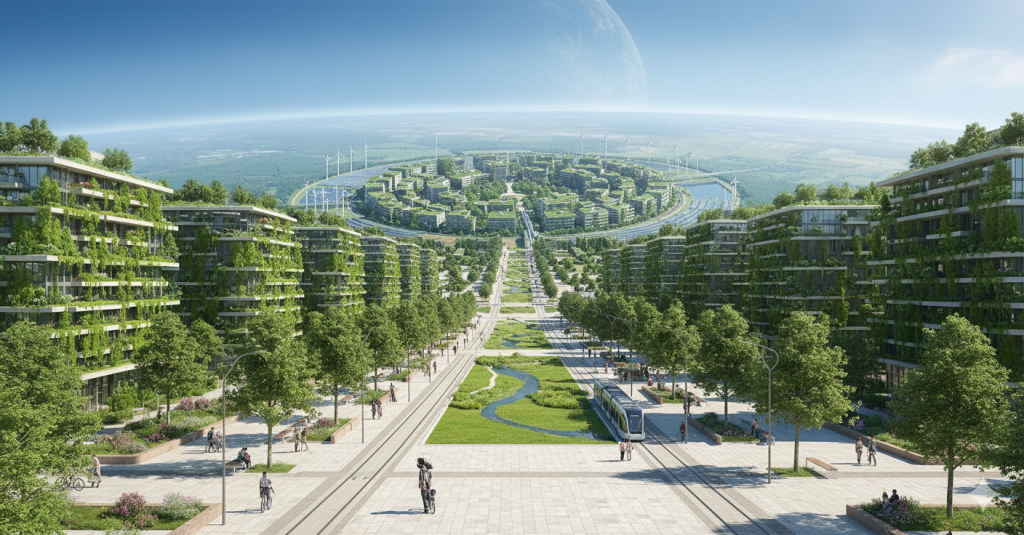
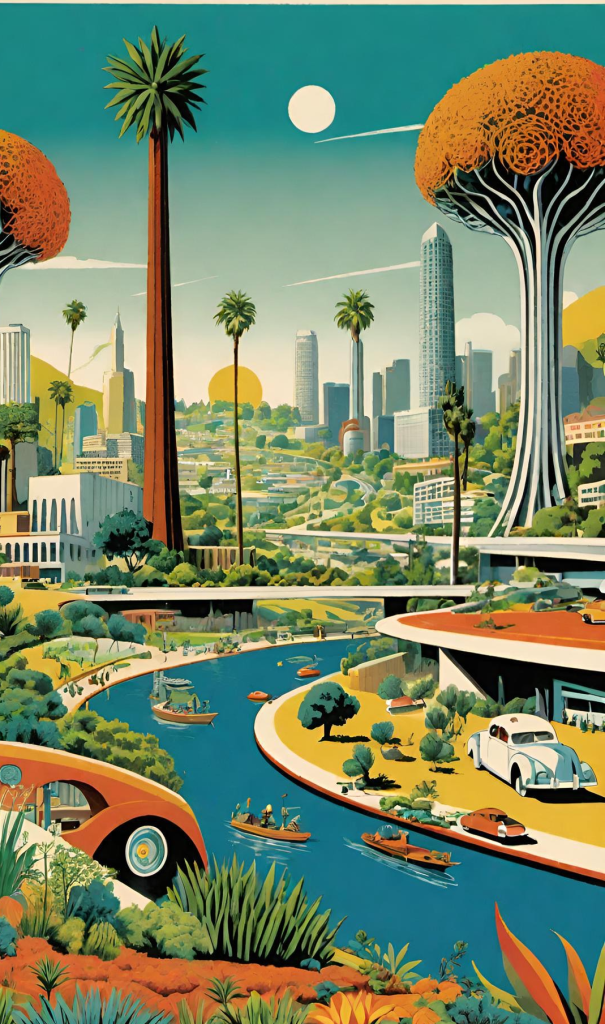
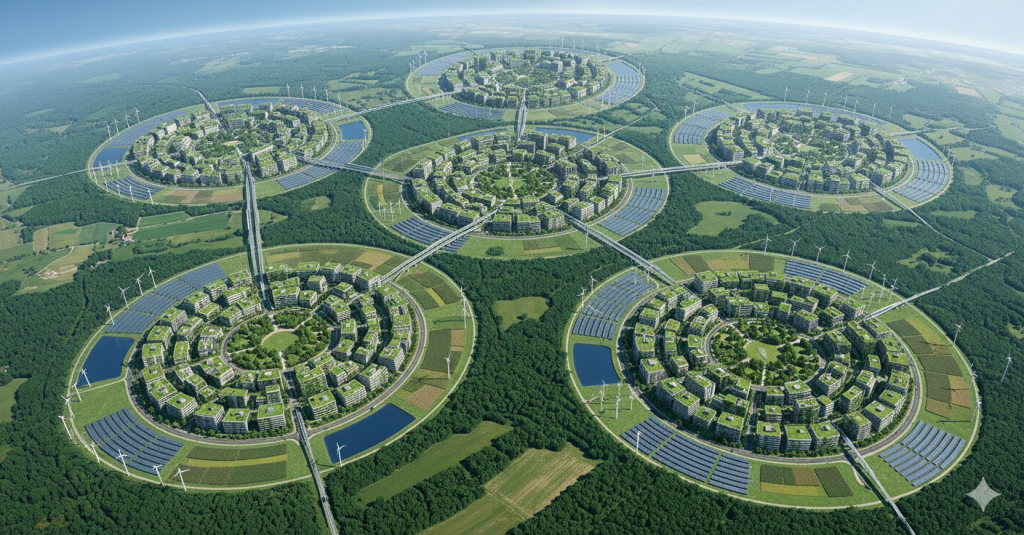
La Cosescha — “The Harvest” — is a speculative future set in the vast, rewilded basin of Los Angeles. A century of ecological reckoning has transformed the city beyond recognition. Where freeways once fractured neighborhoods and concrete suffocated the earth, over a thousand micro-cities now breathe in the canopy shadow of food forests. The world of La Cosescha is not utopia. It is a living, contested, deeply human experiment in what comes after collapse — and after the slow, aching work of repair.
At the heart of this world stands ‘La Cosescha’ itself: a micro-city in the Topanga corridor, the sacred connective tissue linking every micro-city in the basin. It is at once a commons, a marketplace, a parliament, and a cathedral. Here, people barter, grieve, celebrate, and govern. Here, the city breathes.
THEMES
The Collective Over the Individual
La Cosescha imagines what becomes possible when stewardship replaces ownership — when the city belongs to everyone who tends it, and belonging is earned through care rather than capital. The fundamental unit of identity is no longer the self, but the micro-city, the watershed, the canopy.
The Circular Economy
Nothing in this world is waste. Energy, water, food, and labor all move in cycles that feed back into themselves. Regenerative construction, decentralized power, and harvested rainwater close the loops that extraction once tore open. The old logic of “take, make, discard” is treated here as a historical pathology — something taught in classrooms the way we once taught the dangers of plague.
The Illusion of Knowledge
La Cosescha questions who holds expertise and what kind of knowing is valued. The people most trusted to steward the land are those who have lived closest to its wounds — those on the margins of the old world, the most harmed by its failures. Traditional ecological knowledge, apprenticeship, and embodied learning hold equal standing with data models and civic planning.
Post-Humanist Visions
In this world, nature is not backdrop — it is a rights-bearing participant in civic life. The river has legal standing. The forest has a voice in council. Humanity is one thread in a web, not the weaver.
ENVIRONMENT
The Rewilded Basin
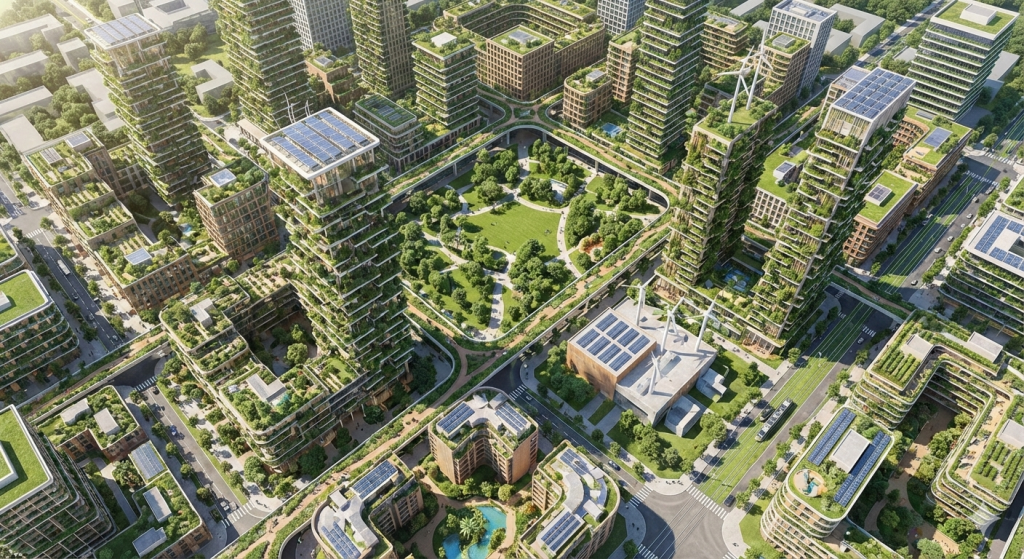
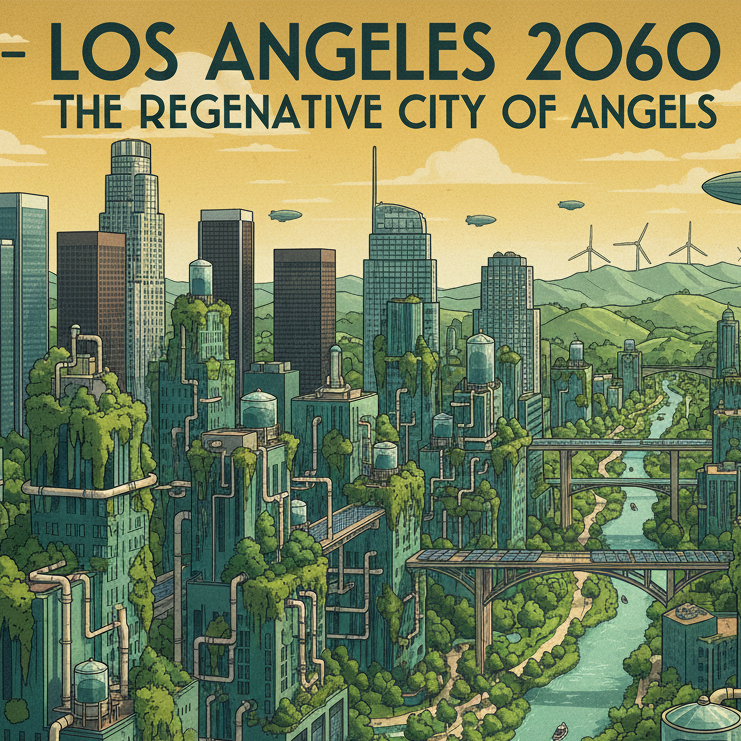
Los Angeles has been transformed by law, labor, and time into a layered canopy of wild and cultivated green. Legislation passed in the years of crisis mandated that every new building incorporate the greenery it displaces — rooftop gardens, balcony food forests, living walls heavy with fruit and root. Existing structures were retrofitted: vines climbing old concrete towers, apiaries on flat roofs, moss-covered parking structures returned to the watershed.
Water as Life, Not Infrastructure
The city has made the great transition from drainage to retention. Rainwater is captured, channeled into wild spaces, and held in constructed wetlands and earthen swales. The old flood control channels have been cracked open and seeded. Creeks run again where they were once buried. The basin drinks what falls from the sky rather than racing it to the sea.
Nature Has Rights
The rivers, forests, and wild corridors of the basin hold legal personhood. Bioregional councils act as their proxies in governance — not to speak for nature in a metaphorical sense, but as a structural, enforceable civic reality. Harming the watershed carries the same weight as harming a person.
The Food Forest
Stretching across the Topanga corridor and threading between micro-cities, La Cosescha is the living spine of the region. It is a self-sustaining, multi-layered food forest — canopy trees giving way to understory fruit, berry bramble, root vegetable, and ground cover. It is tended collectively, harvested communally, and serves as the primary meeting ground between micro-cities. Trade, diplomacy, and ceremony all happen beneath its boughs.
Micro-Cities
The old sprawl of Los Angeles has been re-zoned into self-sustaining micro-cities, each spanning roughly seven blocks. Every micro-city is designed for walkability and self-sufficiency — residents grow food, generate power, and govern themselves locally. Single-family zoning has been replaced by multifamily, communal dwelling. Personal vehicles have been abolished in favor of shared transit and the radical redesign of the street as civic commons. Over a thousand micro-cities now exist across the basin, each with its own culture, dialect of governance, and relationship to the food forest that connects them all.
TECHNOLOGY & SYSTEMS
Regenerative Construction
Buildings in this world are grown as much as they are built. Carbon-capturing concrete pulls atmospheric carbon into its own structure as it cures. Photovoltaic surfaces are designed to mimic the appearance of naturally growing plants — panels that look, from a distance, like stands of tall grass or climbing vine, generating energy while softening the line between architecture and ecology.
Decentralized Energy
There are no centralized utility companies. Power is generated at the micro-city level through distributed solar, biogas from food waste, and small-scale wind. Communities own their own grids. Energy surplus is shared laterally between micro-cities through a federated network, not sold upward to a corporation.
AI for the Commons
Artificial intelligence is used specifically for city planning, ecological modeling, and resource distribution — always in service of the bioregional councils. Because data centers are known to raise local temperatures, their footprint has been radically minimized: computation is distributed, cooled with reclaimed water, and sited in geothermal-stable areas outside the urban basin. The communities most affected by data center heat have veto power over their placement.
Universal Currency
The economy runs on a universal exchange currency that flows between micro-cities through La Cosescha. Bartering remains common — particularly for food — but the currency system allows for larger civic investments and intercommunity projects. Corporations, where they still exist, are employee-owned and required by law to return a meaningful share of their revenue to the communities in which they operate.
CHARACTER & THE PEOPLE OF THE WORLD
The Bioregional Council
At the scale of the whole basin, an overarching council coordinates the network of micro-cities. The council is composed of proxies — representatives who speak not for constituencies but for ecological domains: the waterways, the tree canopy, the soil, the wild corridors. These proxies are drawn from the people most historically harmed by environmental injustice, a recognition that those closest to the wound understand it best.
Proxies & Service Workers
Service to the bioregional council is embedded in the civic and educational fabric of La Cosescha. Young people, after completing their foundational schooling, enter a mandatory year of service as a proxy worker — participating in rewilding projects, habitat restoration, and resource harvesting. This is not punishment or conscription; it is the mechanism by which civic imagination is built, and by which every generation learns to read the land.
Apprentices & Students of Regeneration
Formal higher education has been restructured around apprenticeship. Rather than enrolling in university immediately after secondary school, students spend time in trades and lifeways — learning directly from practitioners of food forestry, regenerative construction, intercommunity diplomacy, and ecological governance. This period determines what, and whether, they choose to study formally.
Primary Character Archetypes
Nature Representatives serve as the human voice for specific wild systems within the bioregional council. Habitat Restorationists are the skilled workers who rebuild ecological corridors. Resource Harvesters manage the harvest of La Cosescha, coordinating food distribution across micro-cities. Food Forest Caretakers maintain the daily life of the forest itself. Goat Herders practice rotational grazing across fire-prone hillsides, reducing risk while building soil. Intercommunity Diplomats negotiate trade, dispute, and shared infrastructure between micro-cities. Students of Sustainability move through the apprenticeship system, forming the rising generation of stewards.
CULTURE
Hyperlocal Identity
Each micro-city has developed its own culture — its own food traditions, its own aesthetic, its own seasonal rhythms. Identity is deeply local, rooted in place rather than nationality or brand. Yet the food forest creates a common ground: La Cosescha is where micro-city cultures meet, trade, argue, celebrate, and intermarry.
From Ownership to Stewardship
The psychological shift at the heart of this world is the move from ownership to stewardship. Land is not owned; it is tended. Buildings are not private property; they are communal infrastructure held in trust by those who inhabit them. Everyone has a stake in the city because everyone participates in maintaining it. Pride comes not from what one possesses, but from what one has nurtured.
The Inner Life as Civic Value
Self-awareness, emotional literacy, and the practice of attention are treated as public goods. Forest bathing — the practice of slow, receptive immersion in the forest — is a cultural institution, observed seasonally and collectively. Mental and spiritual health are not private matters; they are understood as inseparable from the health of the community.
Education Without Walls
Schooling in La Cosescha is inclusive of every learning style, sensory experience, and cognitive mode. Elementary education is rooted in the land — children learn ecology, civic responsibility, and interdependence alongside reading and mathematics. The curriculum is called the Sustainable Curriculum, and it is designed not merely to transmit knowledge but to instill a deep, embodied sense of ownership over the living world and the community that inhabits it.
No Personal Vehicles
The abolition of private automobiles was both a practical necessity and a cultural transformation. Streets are now commons — market, garden, playground, gathering space. Transportation is shared, frequent, and free. The city is designed to be navigated on foot, by bicycle, and by a light transit network that centers at a hub point in each micro-city, making the basin legible and traversable for all.
PRIMARY CONFLICTS
The Black Market
Fossil fuels, combustion engines, privatized water, and centralized energy are contraband — but they are still desired. A thriving black market persists in the gaps between micro-cities, fueled by those who remember the old convenience and those who profit from nostalgia. Corporations that survived the transition maintain quiet ties to these networks, trading in scarcity they manufacture themselves.
Wealthy Enclaves & Hoarding
Not all of the basin converted equally. Certain enclaves — remnants of the old wealthy neighborhoods — have resisted integration into the micro-city network, maintaining private land, private security, and private infrastructure. They engage with La Cosescha selectively, taking from the commons without contributing to it. Their continued existence is a wound in the system, and a political flashpoint.
The Oligarchy
Beneath the civic architecture of La Cosescha, old concentrations of wealth and influence have not disappeared — they have adapted. Those who were rich in the age of extraction have found new mechanisms of control: influence over AI planning models, monopolies on regenerative technology patents, quiet ownership of land held just beyond the reach of bioregional law. The tension between democratic stewardship and entrenched capital is the defining political drama of this world.
The Cost of Transition
Every regenerative decision carries a cost-benefit analysis that is contested. How much disruption is acceptable in the name of long-term repair? Who bears the burden of transition, and who reaps its rewards? The communities that suffered most under the old system are often asked to sacrifice again in the name of the new one. This is the moral wound at the center of La Cosescha — and the question that drives its most urgent stories.
Deprogramming from Capitalism
The subtlest conflict is interior: the slow, generational work of unlearning centuries of competitive, extractive thinking. Older citizens carry the psychic residue of the old world. The impulse to privatize, to hoard, to accumulate — these do not vanish with legislation. They resurface in individuals, in micro-city politics, in the way trade negotiations go wrong. La Cosescha is not a world that has solved human nature; it is a world learning to work with it.

WORLD HISTORY & ORIGINS
The turning point came during an era of compounding extreme weather events — wildfire seasons that swallowed whole communities, flooding that overwhelmed the drainage infrastructure of the old city, heat waves that killed the vulnerable and exposed the bankruptcy of a system built on cheap energy and cheap land.
The first regenerative micro-city was established in the Topanga area — a zone already accustomed to living at the edge of the wild, already practiced in community self-reliance. Its early residents rezoned abandoned lots, reclaimed empty commercial buildings, replanted fire-scarred hillsides with fire-resistant food forest species. Word spread. The model replicated. Over two generations, the basin transformed.
La Cosescha — the food forest that grew from those first planted acres — became the symbol and the substance of everything the new world was trying to become. The name was chosen deliberately: a harvest implies that something was planted long ago, and that the people who planted it may not be the ones who eat from it. It is an act of faith across time.
La Cosescha. The Harvest. The beginning that comes after the end.
Field Notes From Fabrice:
In less than two hours, strangers and colleagues and a small, spirited community came together to imagine an entirely new world.
People drifted in and out throughout the morning — each one leaving a fingerprint on the vision. What struck me was how naturally the conversation kept pulling toward prediction: what could happen, what will happen. And more than once I had to gently redirect us — because this experiment wasn’t about forecasting. It was about desire. The future we collectively, and deliciously, want.
The room held a beautiful range of minds. A USC student studying city planning. A representative from LA Climate Week. A member of LA STEM Collective. And others whose disciplines I couldn’t always name but whose visions were unmistakable. From the youngest voice to the most seasoned, everyone brought something irreplaceable.
What moved me most was watching the arc of it — the hesitation first, the careful thinking, and then that moment. That zap. The spark behind the eyes when the world being imagined begins to take shape, when it stops feeling like an exercise and starts feeling like a place that already exists somewhere, just waiting to be named. That is the art of worldbuilding. That is why it matters.
Some ideas were entirely new. Others lived within post-humanist traditions I’d encountered before. But together, in that room, they formed something that felt like evidence — that even as the old world decays around us, there is a way forward. That a city could be reimagined at the most human scale. That a microspace could be built around connection and intentionality. That nature could have a seat at the table, not as backdrop, but as participant.
We need this more than ever.
In Their own words:
Photo Gallery
Bring the Radical Imagination Project to your community or school: fabrice@syllble.com
Partner acknowledgment: Thank you to Planet in Mind and NY Bagel Cafe